Buying eBay lots to resell: how to evaluate a bundle and break it up profitably
A lot listing is a seller trading money for time. They would rather sell forty things once than forty things forty times, and they price the bundle accordingly. For a reseller that can be the best sourcing on eBay or a garage full of things nobody wants. The difference is in how you read the photos, how you do the maths, and how honestly you count the work of splitting it up.
By Andrew Galvin, Founder of eSnipe11 min readUpdated
On this page8 sections
- 01Why lots sell for less than the sum of their parts
- 02Keywords for finding lots, bundles and job lots
- 03How to evaluate a lot from the photos
- 04Doing the maths: per-unit cost and realistic resale
- 05Fees and the costs people forget
- 06Categories where lots work, and where they don't
- 07Breaking up a lot without leaving yourself the leftovers
- 08Setting alerts for lot listings
Why lots sell for less than the sum of their parts
Every item in a lot could, in principle, be listed and sold on its own. The seller chose not to, and that choice is the source of the discount. Photographing, describing, listing, packing and posting forty items is days of work; one lot is an hour. Sellers who list lots are usually clearing an estate, a collection they have lost interest in, a shop's leftover stock or a loft, and they are paying for convenience with margin.
The buyer pool is also thinner. A single item attracts everyone who wants that item; a lot of forty mixed pieces attracts only people who want most of them, or who are prepared to sell on what they do not want. Collectors are often put off by the duplicates and filler, which leaves resellers as the main competition. And lots carry uncertainty: blurry group photos, vague titles and unknown condition all push the price down, because buyers discount for what they cannot see.
That uncertainty is where the opportunity lives. A lot titled “box of old fountain pens, untested” has done none of the identification work. If you can recognise the two valuable pens in the photo that the seller did not, you are buying information the seller did not have. The same principle applies across categories: lots reward knowledge more than any other kind of eBay buying.
Keywords for finding lots, bundles and job lots
Sellers describe bundles with a fairly small vocabulary, and it differs a little between countries. In the US, “lot” is the standard word, often as “lot of 12” or “huge lot”. In the UK and Ireland, “job lot” and “joblot” are common, alongside “bundle” and “bulk”. Estate and clearance words mark the kind of lot most likely to be underpriced, because the seller is not a specialist.
Pair a lot word with a category word rather than searching lot words alone, which return everything from screws to socks. “Fountain pen lot”, “hand plane job lot”, “fishing lure lot”, “costume jewellery bundle” and “diecast cars lot” are all tight enough to read in one sitting. Then add negative keywords for what you never want to see, such as “reproduction” or “new”, depending on the category. Do not add the lot word itself to your negatives on these searches, which sounds obvious but is an easy mistake when copying an exclusion list from a single-item search.
- General: lot, lot of, bundle, bulk, collection, assorted, mixed
- UK and Ireland: job lot, joblot, bundle, car boot, house clearance
- Seller-type signals: estate, clearance, attic find, loft find, inherited, grandad's
- Condition signals worth a look: untested, as found, unsorted, spares or repair
- Usually avoid: mystery box, mystery bundle, grab bag
How to evaluate a lot from the photos
A lot's photos are the whole case for buying it, so read them as evidence rather than as a sales pitch. Start by counting. Does the number of items you can see match the number in the title? Group photos often hide items behind others, and some sellers photograph a sample of a larger lot, which makes the rest an unknown. If the description says “not all pictured”, treat the unpictured part as worth nothing in your sums, and anything good in it as a bonus.
Next, identify the standouts. Most profitable lots are carried by a small number of items that are worth more than the rest put together. Zoom into every photo, read every label, maker's mark and model number you can, and look each one up in sold listings before you think about the filler. If you cannot identify anything that would sell well on its own, the lot is probably priced about right and the margin is thin.
Then look for what is wrong. Rust, cracks, missing parts, water damage, yellowed plastic, corrosion in battery compartments and broken tips are all visible if you look for them, and they change the value of the standouts more than the filler. Notice what the photos avoid: if every item is shown face-up and nothing shows backs, screens, or the inside, ask the seller for more photos. A seller who obliges quickly is a good sign; one who refuses on a high-value lot is telling you something.
Finally, judge the seller's knowledge from the title and description. A lot described with correct model names and an accurate condition summary has probably been priced by someone who checked. A lot described as “old stuff from the shed” has not, and that is the kind of lot where the margin is.
- Count the items and compare with the title; value unpictured items at zero.
- Identify the standouts first and check their sold prices individually.
- Look for damage on the standouts, not just the filler.
- Ask for missing angles; note how the seller responds.
- A vague, non-specialist description is often where the underpricing is.
Doing the maths: per-unit cost and realistic resale
The question is not whether the lot contains valuable items but whether, after every cost and a realistic sell-through rate, you end up with more than you spent. The easiest way to answer it is to sort the contents into tiers before you buy. Tier A items are worth listing individually. Tier B items are worth selling, but only as smaller sub-lots. Tier C items are worth little or nothing and will be donated, recycled or binned.
Total cost is the lot price, the inbound shipping, and any tax you pay at checkout. Expected revenue comes from tier A sold prices plus a rough figure for the tier B sub-lots, discounted for the fact that not everything will sell, or sell quickly. From that revenue take off eBay's selling fees on each sale, outbound shipping and packaging for each parcel, and a little for returns. What is left, set against your time, is the real profit.
Here is an illustrative example, not a real market. Imagine a lot of thirty vintage hand tools for a total of 120 including shipping. Three planes and a brace identifiable in the photos have recent sold prices that suggest around 180 together. Ten more tools might sell as two sub-lots for about 60 combined. The remaining sixteen are worn and common. Before costs, that is roughly 240 of resale value from a 120 outlay. But four separate sales of heavy tools, plus two sub-lots, means six parcels of outbound shipping, six sets of fees, packaging, and several hours of cleaning, photographing and listing. Done honestly, the margin is real but much smaller than the headline doubling, and it disappears if one of the planes turns out to have a cracked casting. That is why experienced lot buyers insist the tier A items alone cover the purchase.
| Line | Example | Notes |
|---|---|---|
| Lot price plus inbound shipping | 120 | What you pay at checkout |
| Tier A: 4 items sold individually | about 180 | From recent sold listings for each item |
| Tier B: 10 items as 2 sub-lots | about 60 | Discount for slower sales |
| Tier C: 16 items | 0 | Donate, recycle or bin |
| Selling fees, 6 sales | check eBay's fee page | Usually a percentage of each sale plus a per-order fee |
| Outbound shipping and packaging | 6 parcels | Heavy items cost more to post |
| Your time | several hours | Cleaning, photographing, listing, packing |
Categories where lots work, and where they don't
Lots work best where the contents are small, durable, identifiable and individually valuable enough to list. Collectable categories with a long tail of desirable variants fit that description: fountain pens, pocket knives, fishing lures, diecast cars, vintage costume jewellery, watches sold as “spares or repair”, hand tools, sewing machine attachments and older technical books. In each case one buyer's “box of old stuff” contains pieces another buyer is actively searching for by name.
Lots work badly where the contents are heavy and cheap, hard to test, or prone to fakes. A pallet of mixed household goods costs a fortune to post on in pieces and sells slowly. Bundles of modern electronics carry the risk of locked, broken or stolen devices, and testing each one takes time. Designer clothing and accessories in bulk are a common route for counterfeits. And “mystery boxes” are priced by people who know exactly what is in them, which is rarely good news for the buyer.
Your own knowledge should decide more than any list. Buy lots in categories where you can identify the valuable item from a blurry photo faster than the seller could look it up, and stay out of categories where you would be relying on luck.
Breaking up a lot without leaving yourself the leftovers
When the lot arrives, check it against the photos and the listing first. If something pictured is missing or significantly different, raise it with the seller promptly through eBay, while the purchase is still within the window for a not-as-described request. Then sort it into your tiers again with the items in hand, because condition is always a little different from the photos, in one direction or the other.
List the tier A items first. They recover most of your money and tell you quickly whether your estimate was right. Group tier B into sub-lots that make sense to a buyer, by type, maker or use, rather than by whatever was left over; “six Stanley block planes” sells better than “assorted tools”. Keep the tier C remainder out of your listing queue entirely. Many resellers sell the final odds and ends as a single, cheap lot of their own, which completes the cycle and hands the next buyer the same opportunity you had.
Keep a simple record for each lot: what you paid, what each piece sold for, the fees and postage, and the date the last item sold. After a handful of lots, that record tells you which categories and which seller types actually pay, and how long your money is tied up, which is worth more than any general rule.
Setting alerts for lot listings
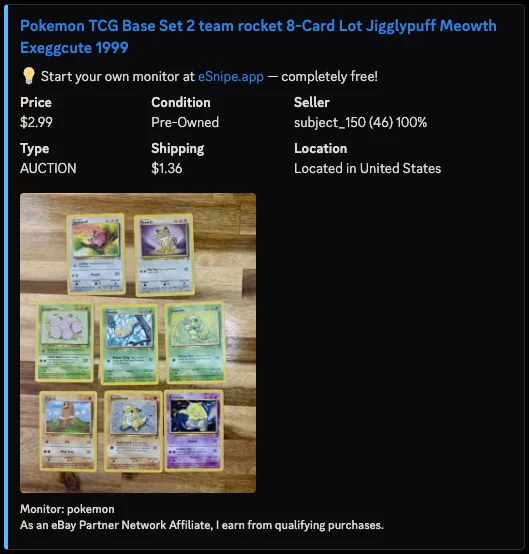
The best lots, the ones from non-specialist sellers with a valuable item visible in the photos, are bought quickly by whoever spots them, so a search you check once a day will mostly show you what other people passed over. An alert closes that gap. In eSnipe, a monitor with keywords like “fountain pen lot” or “hand plane job lot”, a maximum price that matches the amount you would risk on an uncertain bundle, and negatives for the obvious junk will notify you within about a minute of a matching listing going live, with no eBay account needed to run it.
Lot alerts need more thought per notification than single-item alerts, so route them to a Discord channel you check in blocks rather than to a phone push that demands an instant decision. Leave the listing type on both auctions and Buy It Now: lot auctions with no bids are a common source of bargains, and an alert at listing time gives you days to research the contents before the auction ends. eSnipe sends the alert and nothing more; evaluating the photos and making the purchase are yours to do on eBay.
Questions about buying eBay lots to resell
Is buying lots on eBay to resell profitable?
It can be, when you can identify valuable items in the photos that the seller did not, and when the best few items alone cover the purchase. Count selling fees, outbound postage, packaging and time on every resale before deciding.
What does job lot mean on eBay?
It is a UK and Irish term for a bundle of items sold together, often mixed or unsorted. Search “job lot” and “joblot” alongside a category word to find them, the way US buyers search “lot of”.
How do I work out the value of an eBay lot?
Sort the contents into items worth selling individually, items worth selling as smaller groups, and items worth nothing. Look up recent sold prices for the first group, add a conservative figure for the second, then subtract fees, shipping, packaging and your time.
Should I buy eBay mystery boxes to resell?
Generally no. The seller knows the contents and has priced the box accordingly, so the expected value usually favours them. Lots with clear photos of identifiable items are a much better bet.
What eBay fees apply when I resell items from a lot?
Each resale is charged eBay's selling fees, typically a category-dependent percentage of the sale plus a per-order charge, with possible insertion fees beyond your free allowance. Check eBay's current fee page, as rates vary and change.